The Internet Has Become a Crime Scene
Investigation
Who Controls the Evidence?
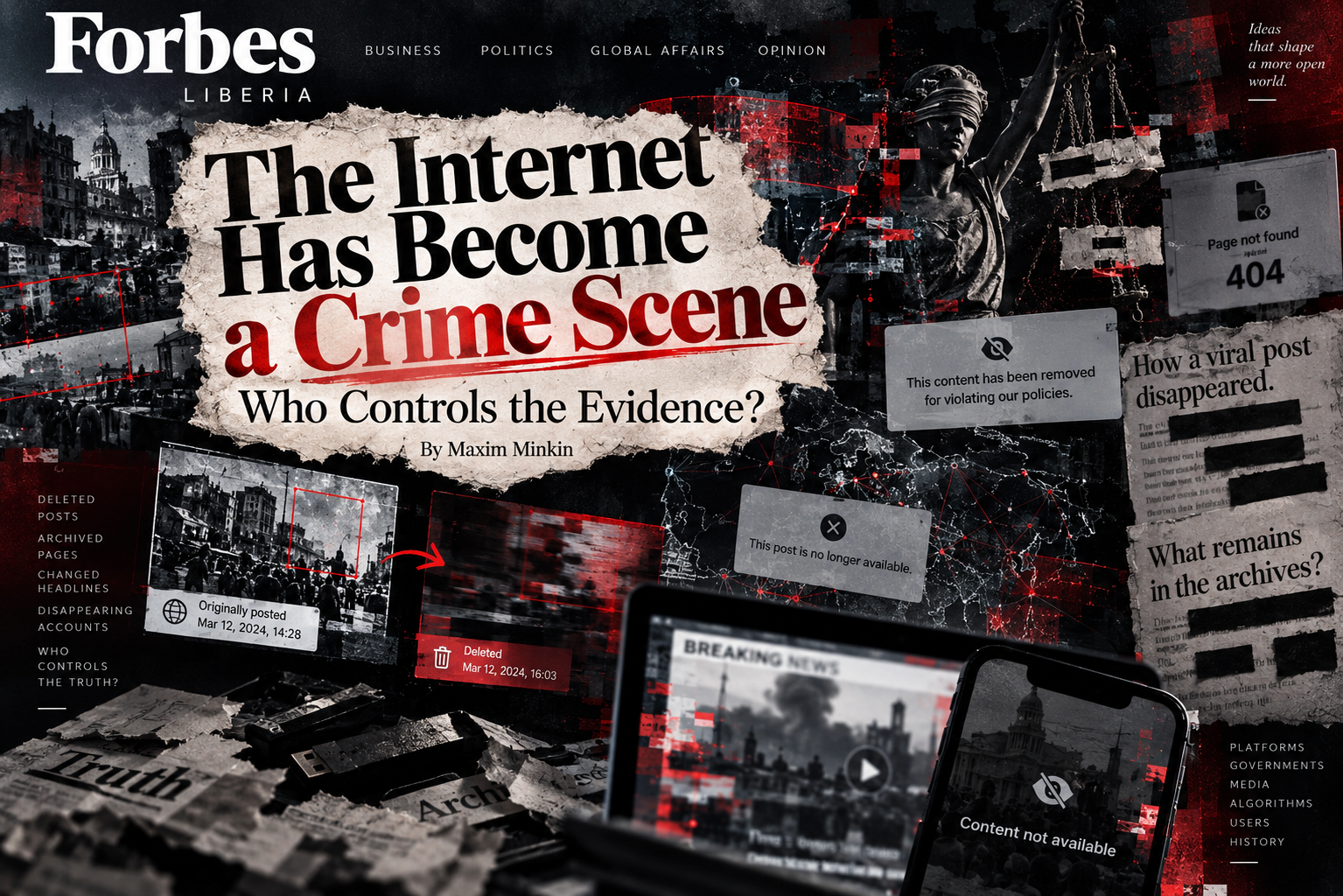
A post appears online. Within hours, thousands of people see it. Screenshots spread, journalists quote it, politicians respond — and then the original disappears. The account is suspended, the video is removed, an article is quietly rewritten, or a link that worked yesterday suddenly leads nowhere.
For most people, the story ends there. For journalists and researchers, however, that may be the moment an investigation begins. We often say that the internet never forgets, but the reality is very different. Much of the information we rely on is stored on private platforms that can remove, modify or restrict access to it. This creates a question that is becoming increasingly important: who controls the evidence of what happened online?
The Evidence Is There — Until It Isn’t
A deleted post does not necessarily disappear completely. Screenshots may survive, someone may have downloaded the video, another website may have quoted the original, and an archived version may still exist. Services such as the Wayback Machine have therefore become important tools for journalists investigating webpages that have been changed or removed.
But digital archives are not perfect. Not every page is captured, some content is inaccessible, and websites can change faster than they can be preserved. The result is a strange kind of historical record: we do not necessarily see everything that happened online. We see what survived.
When Platforms Control the Archive
The problem becomes even more complicated when information is held by social-media companies. For years, journalists and researchers used Meta’s CrowdTangle to study public content on Facebook and Instagram, including misinformation and political campaigns. Meta shut the service down in August 2024 and moved researchers toward its Meta Content Library and API.
The transition generated criticism from researchers and journalists who argued that important forms of access and transparency had been lost. This may sound like a technical dispute about software, but it is actually a dispute about evidence. A journalist investigating an election may need to know not only what is visible today, but what was posted yesterday, how quickly it spread and what happened before it was removed.
If that information is inaccessible, part of the story becomes impossible to reconstruct.
What Happens When Evidence Disappears?
Imagine a political story spreading across social media. A researcher begins mapping the accounts involved, but thousands of posts disappear over the following months. The researcher can study what remains, but cannot study what was never preserved.
That is one of the biggest problems with digital research: missing information does not always look like a gap. It simply becomes invisible. European regulators have recognized the issue. Under the Digital Services Act, vetted researchers can request certain data from very large online platforms and search engines, including information connected to content that has been removed.
The existence of such rules highlights the underlying problem: some of the evidence necessary to understand the modern internet is held by companies that the public cannot independently inspect.
A New Kind of Forensics
Digital journalism increasingly requires forensic thinking. Investigators compare archived webpages, screenshots, timestamps, URLs and independent copies to reconstruct what happened. The question is no longer simply, “Is this post real?” It is also: When was it published? How far did it spread? Was it changed? When did it disappear? And what evidence remains?
That distinction matters because removing content does not necessarily erase its impact. A video can influence millions of people before being deleted, and a false claim can shape a political debate long after its original source has disappeared.
There are legitimate reasons to remove content. Platforms must be able to act against illegal or dangerous material, and individuals deserve privacy. But removal and preservation do not have to be opposites. Content can be removed from public view while appropriate records are preserved for journalists, researchers or legal authorities. The difficult question is who controls those records — and who gets access to them.
Who Gets to Decide What We Remember?
There is no single organization controlling the internet’s memory. Platforms control some information, governments control other parts, publishers edit their archives, users delete their accounts, and search engines determine what is easy to find. Together, they shape what remains visible.
The internet was supposed to make information permanent. Instead, it may be creating a historical record where some of the most important evidence disappears before anyone has decided how important it is.
Sources:
1) Meta - “New Tools to Support Independent Research”