The Englishwoman Is Up to No Good
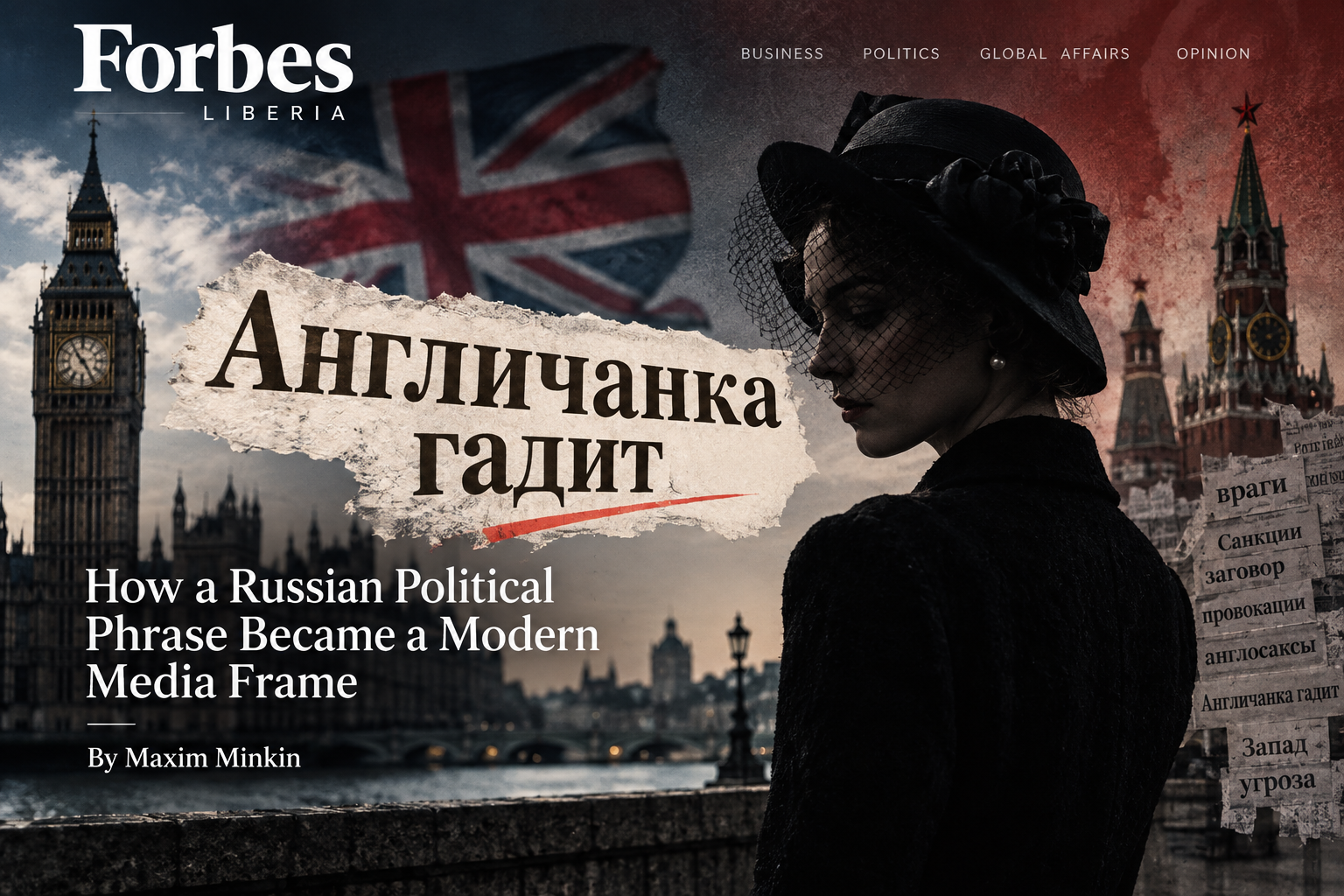
How a Russian Political Phrase Became a Modern Media Frame
There are political phrases that disappear with the generation that created them. Others survive for decades, sometimes centuries, changing their meaning as the political world around them changes.
“The Englishwoman Is Up to No Good” belongs to the second category. The expression has a long history in Russian political culture, where it has been used to suggest British interference, hostility or hidden political manoeuvring.
Today, the phrase can still appear in discussions of Britain and Russia. But its persistence raises a broader question: how does an old political expression become a modern way of interpreting events?
The history of this phrase offers an example of how political language can do more than describe reality. It can also provide audiences with a ready-made explanation for it.
Where Did the Phrase Come From?
The expression is frequently attributed to the Russian military commander Alexander Suvorov. However, there is no reliable documentary evidence that Suvorov actually coined or used the exact expression. Researchers examining the claim have found no convincing primary source establishing him as its author.
A different explanation connects the phrase to a much older literary tradition.
In Nikolai Gogol’s The Government Inspector, a character attempts to explain an unexpected development by blaming a foreigner. The joke lies partly in the simplicity of the explanation: instead of examining the circumstances themselves, the character immediately looks for an external culprit.
Historian Alexander Dolinin has argued that the later expression developed within a similar linguistic pattern. A foreign power could be turned into a convenient explanation for political events, and the identity of that foreign power could change according to the historical circumstances.
By the late nineteenth century, Britain increasingly occupied this role in Russian political discourse. Dolinin traces the spread of the specific expression to newspapers of the 1890s, particularly during a period of intensified Russian-British rivalry surrounding the Anglo-Boer War.
This history is important because it suggests that the phrase was not necessarily invented by one famous individual. Instead, it appears to have emerged through the interaction of popular language, political anxiety and media repetition.
Why Britain?
The historical rivalry between Russia and Britain was real.
Throughout the nineteenth century, the two empires competed for influence across Europe and Asia. Their relationship included both cooperation and confrontation, but Britain increasingly became an important symbol of geopolitical competition in Russian political culture.
A complicated international relationship, however, is difficult to communicate in a short sentence.
The phrase solved that problem by turning an entire geopolitical relationship into a character.
“The Englishwoman” does not literally refer to a particular woman. It functions as a metaphor for Britain itself — and, depending on the context, for its government, political establishment or alleged influence.
The second part of the expression is equally significant. “Up to no good” does not describe a particular policy or action. It describes an assumed intention.
The result is a very compact political narrative:
Britain is not simply doing something controversial. Britain is assumed to be doing something wrong.
That distinction helps explain why such expressions can survive long after the circumstances that originally produced them have changed.
From a Phrase to a Media Frame
A media frame is not simply a headline. It is a way of selecting and organising information so that audiences are encouraged to understand an event from a particular perspective.
“The Englishwoman Is Up to No Good” works effectively as a frame because it is immediately understandable.
A complicated diplomatic dispute may require several paragraphs of context. A familiar political expression can communicate an interpretation in a few words.
This is especially relevant in modern media environments, where information moves rapidly between television, newspapers, social networks, messaging platforms and short-form video.
A political phrase can begin as a comment on television, appear in a headline, circulate through social media and eventually return to mainstream discussion as something that feels familiar.
Repetition matters.
The more frequently an expression is associated with a particular country or political actor, the easier it becomes to use that association when interpreting the next event.
The audience may therefore encounter the conclusion before encountering the evidence.
That does not mean that every use of the phrase is propaganda. It can be used ironically, historically or critically. Context matters.
The more interesting question is therefore not whether the expression is automatically propagandistic, but under what circumstances does a historical phrase become a mechanism for political framing?
From Governments to People
One of the most important problems with political shorthand is the tendency to blur the distinction between governments, countries and populations.
A government is a political institution. A country contains many different institutions, communities and opinions. Citizens are individuals who may strongly disagree with their government.
Political language can easily compress these different categories into one.
Criticising a British government policy is not the same as claiming that Britain as a society is inherently hostile. Analysing a geopolitical conflict is not the same as assigning a permanent character to an entire population.
The phrase becomes particularly powerful when it crosses this boundary.
Instead of discussing a specific decision, it can create the impression of a permanent national characteristic: Britain is simply “up to no good.”
This mechanism is not unique to Russia or Britain. Political communication across the world frequently relies on national stereotypes, simplified labels and historical metaphors.
The broader lesson is that political language can transform complex relationships between institutions into seemingly simple relationships between peoples.
Why Does It Matter Today?
The phrase is historically old, but the mechanism behind it remains relevant.
Contemporary Russian political media frequently uses language that presents Britain as a hostile geopolitical actor. Recent BBC Monitoring analysis has examined the increasing prominence of anti-British rhetoric in Russian political programming and the portrayal of the United Kingdom as a major adversary.
This demonstrates how historical political vocabulary can acquire new relevance in a contemporary media environment.
An expression created in a very different geopolitical era can be reused to interpret events that have little direct connection to its original context.
Its historical origins may disappear from public memory while its emotional meaning remains.
This is one of the most interesting characteristics of political language:
words can outlive the circumstances that created them.
The Business Consequences of Political Narratives
The effects of political framing are not limited to politics.
International businesses operate in environments shaped by trust, reputation and expectations. The way a country is perceived can influence how audiences interpret companies, institutions and individuals associated with that country.
Country reputation can affect perceptions of brands, international partnerships, investment risk and consumer behaviour.
This does not mean that political rhetoric automatically determines economic decisions. Markets are influenced by many factors, including regulation, prices, economic conditions and institutional stability.
But perceptions are part of that environment.
When a country is repeatedly represented as dangerous, unreliable or hostile, those representations can become part of the information people use when making decisions.
This creates an important connection between political communication and international business.
A manager working across borders is not dealing only with financial data and organisational structures. They are also operating within different cultural and informational environments.
Understanding how narratives influence trust and perception can therefore be relevant to understanding international markets and organisations.
What Can Independent Media Do?
Independent journalism cannot eliminate framing.
Every journalist and publication has to decide which events to cover, which sources to use and which questions to ask.
But journalism can make those processes more transparent.
Instead of beginning with a conclusion, journalists can begin with evidence. Instead of treating a political cliché as an explanation, they can investigate its origins, evolution and contemporary use.
The history of “The Englishwoman Is Up to No Good” demonstrates why this approach matters.
At first glance, the phrase appears to be a simple political joke. Once its history is examined, however, it becomes considerably more complicated.
It connects nineteenth-century geopolitical rivalry with literature, newspapers, national stereotypes and the human tendency to search for simple explanations of complicated events.
Studying the phrase therefore does not require taking a position for or against Britain.
It requires asking a broader question:
How do societies construct explanations for the actions of other societies?
A Phrase That Became a Narrative
“The Englishwoman Is Up to No Good” has survived because it is more than a sentence.
It is a compact political narrative.
Its history illustrates how language can travel from literature and popular speech into journalism, from journalism into political discourse, and from political discourse into modern media framing.
That process deserves attention because political language does not exist separately from political reality.
It influences what people notice, which explanations seem plausible and how audiences interpret events they cannot personally observe.
Britain can be criticised. Governments can be challenged. Foreign policy can be analysed critically.
But there is an important difference between examining the actions of a government and turning an entire nation into a permanent political character.
The enduring significance of this phrase may therefore be less about Britain itself than about the power of political language.
A phrase can survive for more than a century. The more important question is what happens when a society begins using it to explain the present.
Sources and Further Reading
- Alexander Dolinin — research on the historical development of the expression and its relationship to nineteenth-century Russian literature and political language.
- Verified Media — analysis of the claim that Alexander Suvorov originated the expression.
- BBC Monitoring / BBC World Service — analysis of contemporary Russian political rhetoric concerning Britain.
- Arguments and Facts — historical discussion of competing explanations for the origin of the expression.