The Algorithmic Election: How Social Media Shapes Political Choice in Germany and Russia
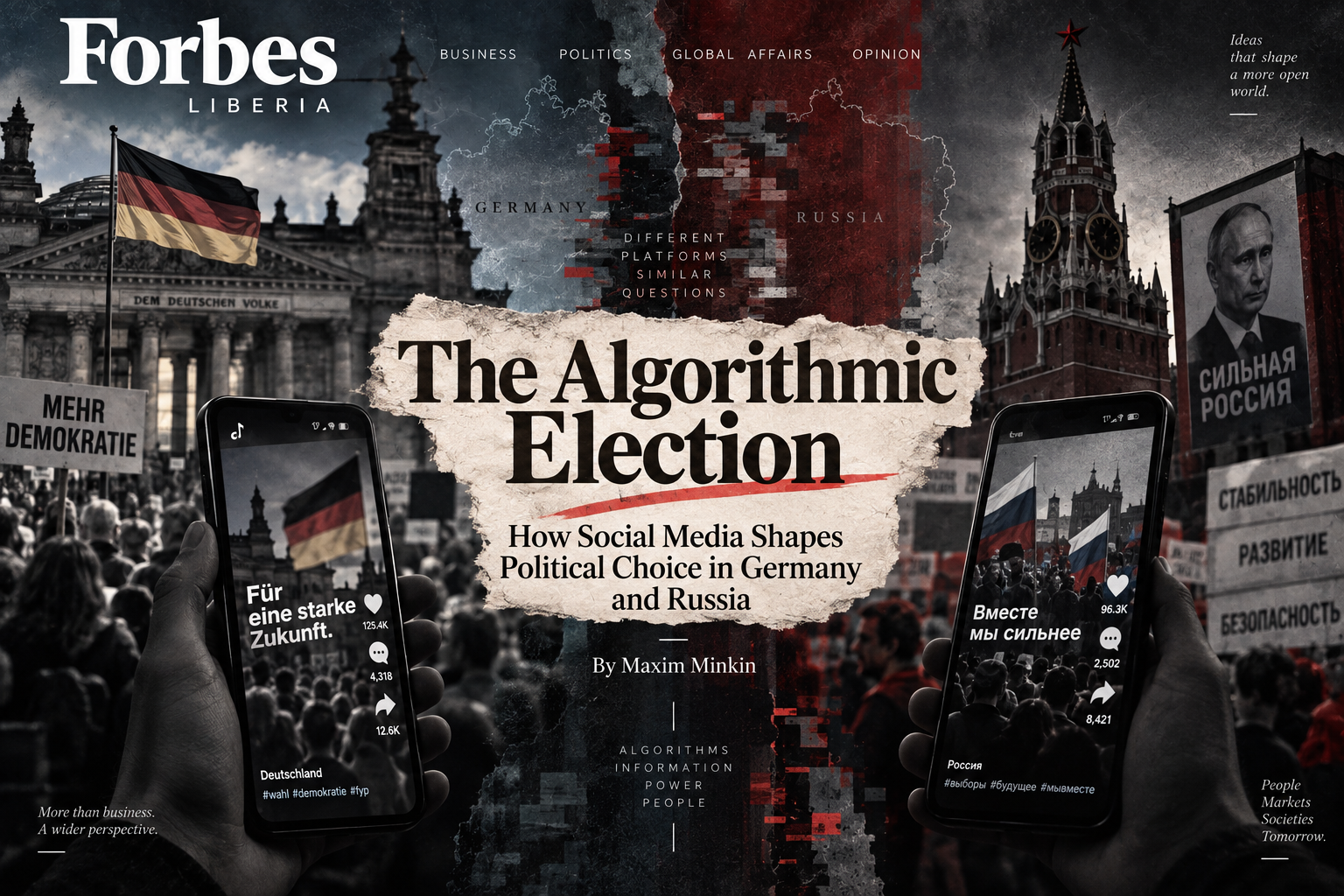
Increasingly, they are fought in our phones.
A voter opens TikTok for entertainment and finds a political video. One clip leads to another. A candidate who was barely known yesterday suddenly appears everywhere. A political slogan becomes a meme, the meme becomes a talking point, and the talking point becomes part of an election campaign.
This is where the idea of the “algorithmic election” comes from.
But there is a problem with the phrase. Saying that “algorithms decide elections” is easy. Proving it is much harder.
Algorithms can influence what people see. They cannot automatically tell us what people will believe, how they will vote, or why they voted that way.
The September 2026 elections in Russia and Germany offer two very different environments in which to examine that distinction.
Russia: an election inside a controlled information environment
Russia’s State Duma election ended on September 20, with preliminary results reported the following day.
According to near-complete results reported by Reuters, United Russia received 57.83% of the party-list vote and was set to hold 355 of the 450 seats in the State Duma. In 2021, the party received 49.8%.
But the numbers alone do not tell the whole story.
The political environment surrounding the election was tightly controlled, with significant restrictions on opposition activity and political competition, according to Reuters.
That matters when we talk about algorithms.
It is tempting to compare Russia and Germany by counting views, likes and reposts. But a political message cannot compete for attention if the wider political environment has already limited who can effectively participate.
In other words, the algorithm is only one part of the system.
Russian election-related social media also illustrates this complexity. Campaign activity takes place across platforms including VKontakte, Telegram and YouTube, while political organisations compete for attention among voters who are already living inside a highly structured information environment.
So the question is not simply: “What did the algorithm recommend?”
It is also: “What was available to be recommended in the first place?”
Germany: when visibility becomes a political resource
Germany presents a different environment.
In Saxony-Anhalt, the AfD received 43.8% of the party-list vote in the September 2026 state election, according to the official results. The CDU received 17.2%, the SPD 9.3%, the Greens 8.9% and Die Linke 8.6%. Turnout was 77.8%.
In Mecklenburg-Western Pomerania, an exit poll on September 20 initially put the AfD at 37.0%, compared with 35.5% for the SPD. Because this was an exit poll, rather than the final count, it should be treated as a projection rather than a final result.
None of these numbers proves that TikTok or another platform caused the AfD’s electoral performance.
But something interesting was happening online.
The TikTok asymmetry
The University of Potsdam’s Social Media Monitor looked at political TikTok activity in Saxony-Anhalt during the campaign.
Between June 1 and August 31, 96 political accounts published 2,227 posts that accumulated 43.4 million views.
One account stood out.
The account of AfD lead candidate Ulrich Siegmund received 28 million of those views — 64.5% of the total. The CDU published more posts than any other party in the dataset, but accounted for around 9% of the views.
That difference is difficult to ignore.
The party posting the most was not the party receiving the most attention.
This is one of the central features of political communication on social media: producing content and receiving attention are two completely different things.
The Leibniz Institute for Media Research found something similar in a separate analysis of 1,323 TikTok videos from 91 political accounts in Saxony-Anhalt.
The CDU produced 380 videos — the largest number in the dataset. Those videos received around 1.9 million views.
AfD videos, by comparison, received almost 21 million views — more than eleven times as many.
And the attention was highly concentrated.
Videos from the AfD’s lead candidate accounted for 81% of all views received by the AfD accounts studied, despite representing only 18% of the party’s videos in the dataset.
The result is a curious paradox.
You can post more and still be seen less.
Did TikTok make voters choose the AfD?
This is where the story becomes much less straightforward.
A high number of views does not automatically mean persuasion.
Someone might watch a political video because they agree with it. They might watch because they strongly disagree. They might watch because the video is entertaining. Or they might watch because the recommendation system has learned that this type of content keeps them on the platform.
We therefore have to separate three things:
visibility, persuasion and electoral behaviour.
They are related, but they are not the same.
Research from the Bertelsmann Stiftung illustrates the problem.
During its experiment around the 2025 German federal election campaign, videos associated with the AfD were recommended particularly quickly in test profiles. Videos containing #afd appeared after an average of around 11–12 minutes, while content associated with #spd took around 70 minutes. AfD-related content also appeared disproportionately often across the platforms examined.
But the researchers themselves warn against a simple causal explanation.
Because recommendation algorithms are not transparent, it is impossible to determine conclusively why some political actors receive more visibility than others. Engagement, comments, likes, views and the style of the videos may all play a role.
And this leaves us with a much more interesting question:
Does the algorithm change the voter?
Or does the voter train the algorithm?
The answer may be both.
Two different forms of algorithmic politics
This is where the comparison between Germany and Russia becomes useful.
In Germany, political parties compete for attention within a pluralistic electoral environment. Social media can give individual candidates enormous visibility, sometimes far beyond what the number of posts they publish would suggest.
In Russia, algorithmic visibility exists within a political and media environment shaped by restrictions on political competition and access to information.
The technology may look similar.
The political environments are not.
That difference matters.
A million views in one political system does not necessarily mean the same thing as a million views in another.
The business problem behind the political one
There is another reason this matters — and it goes beyond elections.
Political algorithms are also part of the environment in which companies operate.
A political narrative can affect how people perceive foreign businesses, brands, immigration, trade, regulation or geopolitical risk.
For an international company, reputation is not created only by advertising.
It is also created by the information environment surrounding the company.
Imagine a company entering a new market.
Its executives may spend months researching consumers, regulations and competitors. But millions of potential customers are simultaneously receiving political narratives about that country’s companies, institutions and people through their phones.
That information may not appear in a traditional market report.
It can still influence the market.
This is why algorithmic politics is also a business story.
Two perspectives from inside the information environment
To complement the research, I also spoke anonymously with two people familiar with political and public-sector environments in Russia and Germany.
Question: Do social-media algorithms influence political attitudes, or do they mainly amplify opinions people already hold?
Russian respondent, speaking anonymously:
«Algorithms… have a very strong influence, as well as all the propaganda that tries to put dust in people's eyes. It's hard to exist in the current reality.»
German respondent, speaking anonymously:
“If we are talking about today, then Germany is going through a phenomenal period, namely, the period in which the leading party loses votes, social networks show people pictures of how they will live by voting for AfD. The intervention of other countries in our elections was recorded, but media pressures force people to turn off their thinking and consume ready-made information”
Their answers can add something that statistics cannot: the experience of people actually living inside these information environments.
But even individual experiences have to be treated carefully.
Two people can use the same platform, see completely different feeds and come away with completely different impressions of the political world.
That is precisely the problem researchers are trying to understand.
Perhaps the most interesting conclusion is not that algorithms “control” voters.
The available evidence does not establish such a claim.
Something more subtle is happening.
Political actors produce messages.
Platforms distribute them.
Users interact with them.
Those interactions generate more data.
The platform then uses that data to decide what to show next.
The cycle continues.
Political message → recommendation → user engagement → further recommendation → greater visibility.
The cycle does not guarantee an election result.
But it can change the information environment surrounding the voter.
It can make some candidates familiar and others almost invisible.
It can make certain issues appear constantly important.
It can turn a political figure into a recurring presence in someone’s daily life without that person ever deliberately searching for them.
That may be the real power of the algorithmic election.
The voter still makes the decision.
But before that decision is made, someone — or something — has already helped decide what the voter gets to see.
Sources
Reuters — Russia’s ruling pro-Putin party wins wartime election with over 57% of vote
University of Potsdam — Potsdam Social Media Monitor
Leibniz Institute for Media Research — TikTok and the 2026 Saxony-Anhalt election campaign
Bertelsmann Stiftung — Algorithms in election campaigns
Official election results — Saxony-Anhalt 2026