Alena Yudina: The Economics of Trust
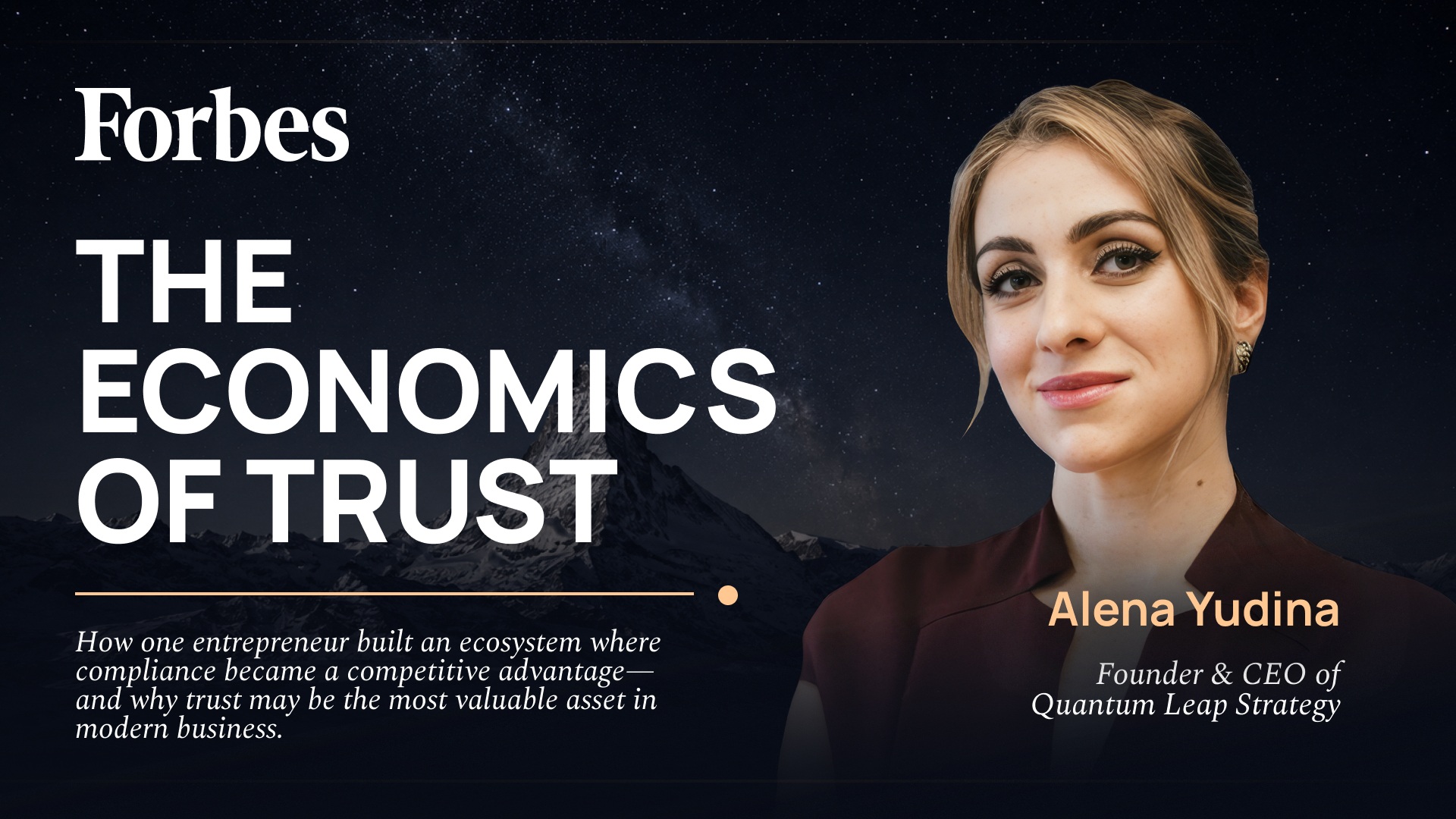
How one entrepreneur built an ecosystem where compliance became a competitive advantage—and why trust may be the most valuable asset in modern business.
For decades, business leaders measured success through familiar metrics: capital, technology, market share and speed. Yet in an increasingly interconnected world, another asset has quietly become just as valuable—one that cannot be raised, copied or acquired overnight.
Trust.
Every investment, every cross-border transaction and every long-term partnership ultimately depends on it. Capital may finance growth, but trust determines whether opportunities become reality. As global regulation becomes more complex and businesses expand across jurisdictions, compliance is no longer simply about meeting regulatory requirements. Increasingly, it has become a strategic advantage.
Few countries understand this better than Switzerland. Its reputation has never rested solely on banking, political neutrality or financial stability. Those qualities matter, but they are rooted in something deeper: institutions that work, laws that are respected and a business culture where reputation is earned over years rather than marketing campaigns. In Switzerland, trust is not a slogan—it is part of the country's economic infrastructure.
It was precisely this philosophy that attracted Alena Yudina, who arrived in Switzerland with a background in business law and compliance, complemented by executive education at the University of St. Gallen's Executive School. She chose one of the world's most demanding business environments because it reflected her own values. Building a company in Switzerland meant adapting to a new language, a new culture and a market where credibility cannot be claimed—it must be earned. She often says she simply fell in love with the country, not only for its beauty, but because it proved that trust, discipline and integrity can become a competitive advantage.
That belief became the foundation of Quantum Leap Strategy, the compliance firm she established in Zug and the anchor of everything she would go on to build. Rather than viewing compliance as a legal necessity, Yudina saw it as an enabler of international business. For companies entering Switzerland, regulatory clarity is often the first condition for attracting investors, opening banking relationships and building partnerships that can withstand scrutiny.
This perspective increasingly reflects a broader shift across global business. As digital assets mature, cross-border regulation expands and investors place greater emphasis on governance, compliance is moving from the legal department into strategic decision-making. It no longer answers only one question: 'Can we do this?' Increasingly, it answers a far more important one: 'Can we build a business that others will trust?'
That philosophy extends across every company Yudina has built.
At first glance, her ventures appear to operate in different industries. Quantum Leap Strategy focuses on compliance and market entry. Fintech Office supports entrepreneurs establishing and operating businesses in Switzerland. MaYu Marketing gives fintech, asset-management and web3 companies the creative and communications strategy to be taken seriously once they are inside the system. Green Wealth Capital provides financial infrastructure, including international payments, escrow services and digital asset solutions. EmTech Invest convenes entrepreneurs, investors, policymakers and technology leaders during the World Economic Forum week in Davos.
Taken separately, they are successful businesses serving different markets.
Viewed together, however, they reveal something more interesting. Together they cover nearly every stage a foreign entrepreneur will pass through in Switzerland—a rare footprint for one founder to hold.
Yudina never set out to build a collection of companies. She simply kept solving the next challenge her clients encountered. Helping entrepreneurs establish a business in Switzerland naturally led to compliance. Compliance revealed the need for trusted financial infrastructure. Financial infrastructure opened the door to escrow, international payments and digital assets. As businesses grew, they needed strategic communications and access to global networks. What emerged was never part of a master plan. It evolved organically—one solution at a time—until it became a fully integrated ecosystem designed to make international business more predictable, transparent and trusted.
That philosophy also shaped EmTech Invest, the international platform she launched in 2019. During the annual World Economic Forum week in Davos, the platform brings together founders, investors, family offices, policymakers and technology leaders for conversations that extend well beyond conference stages. Over the years, it has welcomed more than 4,000 participants from over 100 countries and collaborated with more than 150 partners. Yet the platform's value lies less in the names on the agenda than in the quality of the relationships it helps create.
‘The world doesn’t lack ideas,’ Yudina says. ‘It lacks trusted environments where people are willing to build them together.’
That same principle underpins Green Wealth Capital, where escrow services illustrate one of the oldest challenges in commerce: how two parties who may never have met can confidently complete a significant transaction. Technology can make payments nearly instantaneous, but it cannot eliminate uncertainty. Independent governance, transparent processes and credible institutions still matter. In many ways, escrow is simply trust translated into financial infrastructure.
None of this came without cost. Yudina built her system in a foreign country—a new language, a new business culture, a network of relationships assembled from nothing. There were setbacks the polished version of any success story tends to leave out. She did it while raising three children, a detail she rarely raises herself, as if the two facts belonged in separate conversations. They don't: the discipline that built one made the other possible.
Looking back, Yudina's story is not simply about building companies. It is about building the conditions that allow other companies to grow with confidence. Markets will evolve, technologies will change and regulation will continue to develop. But businesses grow through innovation—and they endure through trust.


