Vietnam Is Building One Financial Centre in Two Cities. Now Comes the Hard Part
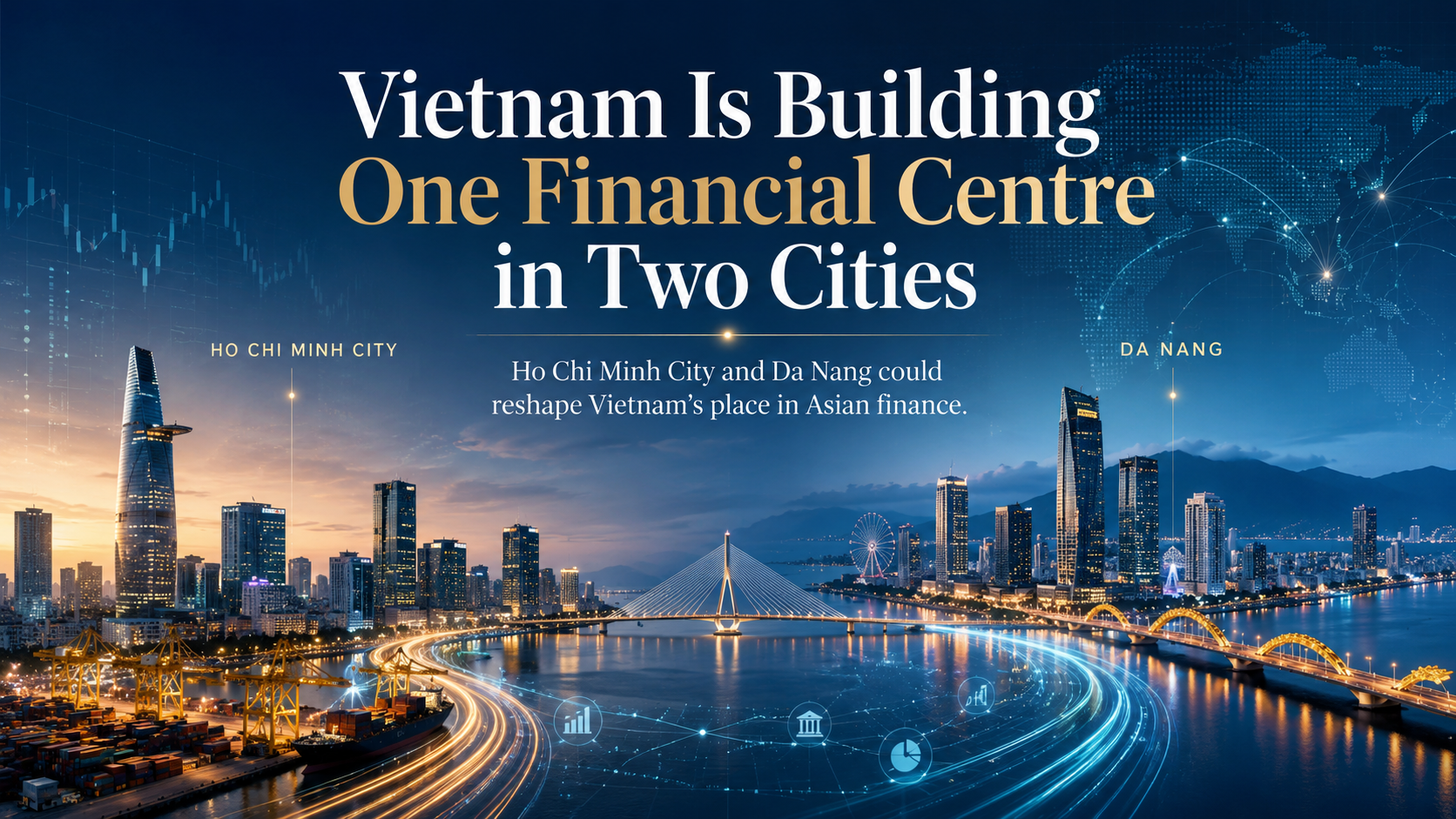
Ho Chi Minh City brings scale and institutional capital. Da Nang brings financial technology, new products and a connection to trade and infrastructure. Vietnam now has to prove that the two can work as one market.
By Guy Yanpolskiy
For most of the past two decades, the Vietnam story has been easy to understand from the outside. Global manufacturers moved production into the country, exports expanded, foreign direct investment followed, infrastructure improved and a new consumer economy emerged around a population of more than 100 million people.
That story is still happening, but it is no longer enough to explain what Vietnam wants to become.
The next problem is capital.
Vietnam estimates that it will need roughly US$1.5 trillion to US$1.6 trillion in total investment between 2026 and 2035 to support its development ambitions. Public resources are expected to cover only about 20 percent of that requirement. At the same time, the financial system remains heavily dependent on bank credit, while investment funds, pension funds, asset managers and other long term institutional investors remain relatively small compared with more mature financial markets. (baochinhphu.vn)
Once you understand that gap, the Vietnam International Financial Centre starts to make much more sense.
VIFC is not important because Vietnam needs another financial district with impressive towers and international logos. It is important because Vietnam needs a better mechanism for connecting capital with infrastructure, technology, energy, private companies and the next stage of economic growth.
That is the real story.
What Is The Vietnam International Financial Centre?
The Vietnam International Financial Centre, or VIFC, was established under National Assembly Resolution No. 222/2025/QH15. The resolution created one national financial centre located in Ho Chi Minh City and Da Nang, operating under a unified framework for management and supervision while allowing each location to develop products around its own strengths. The resolution has been in force since September 1, 2025. (CSDL quốc gia về pháp luật)
The phrase Vietnam uses is simple: One Centre, Two Locations.
I think that phrase is often misunderstood.
It does not mean Vietnam has decided to create two competing financial centres and connect them with a common brand. At least, that should not be the objective.
The more interesting possibility is that Vietnam is trying to build one financial architecture with two very different points of gravity.
Ho Chi Minh City and Da Nang do not need to do the same thing. In fact, if they try to do the same thing, the model becomes much less convincing.
Their differences may be the reason it can work.
Ho Chi Minh City Has The Scale
Ho Chi Minh City is the obvious financial anchor.
It already contains Vietnam’s deepest concentration of banks, securities companies, major corporations, investors, professional services and financial talent. It also sits at the centre of the country’s largest corporate economy.
This makes HCMC the natural location for institutional finance, capital markets, investment funds, asset management and larger cross border transactions.
The first numbers already show the difference in scale.
After roughly six months of operation, VIFC-HCMC reported approximately US$20 billion in investment commitments from domestic and international investors. That is a meaningful number, but it needs to be described carefully. It is committed capital, not US$20 billion already deployed into the Vietnamese economy. HCMC officials themselves have increasingly focused on the more important question: how much of that interest can become real capital, products and transactions.
That distinction matters to me because financial centres are easy to describe before they become markets.
There can be commitments, conferences, memoranda and investor interest. But a financial centre only becomes real when institutions operate there, capital moves through it and financial products develop enough liquidity to become useful.
HCMC now has to cross that line.
On August 17, city leaders met International Finance Corporation representatives to discuss infrastructure financing, green finance and new capital mobilisation mechanisms, including local and international bonds, private investment and public private partnerships. This is the kind of conversation that makes VIFC more relevant. The centre becomes much more interesting when it starts connecting international finance with actual infrastructure requirements rather than existing as an isolated financial project. (SGGP English Edition)
And today, August 24, Vietnam moved another step in that direction.
What Changed On August 24
Vietnam’s National Assembly officially passed the new Urban Development Law today with 465 of 474 participating deputies voting in favour. The law is scheduled to take effect on October 1, 2026, with an earlier effective date for a limited procedural provision. (Chính Phủ)
The important part for VIFC is not simply that the words “international financial centre” appear in another law.
The law begins connecting finance with the physical economy around it.
The final framework contains specific mechanisms for developing the International Financial Centre and gives Ho Chi Minh City additional room to mobilise resources. HCMC authorities describe provisions allowing the city People’s Council to regulate municipal and project bond issuance through the financial centre for major projects, together with mechanisms linking VIFC to free trade zones, integrated logistics areas, open ports, high technology zones and other economic functions. (Chính Phủ)
This is much more important than it may sound.
If VIFC becomes a place where capital can be structured for a metro line, a logistics hub, a port, a technology district or another piece of infrastructure, then the financial centre begins to have a purpose beyond finance itself.
That is where the concept becomes economically meaningful.
The financial centre should not be the destination of capital. It should be part of the infrastructure through which capital reaches the rest of Vietnam.
Da Nang Has A Different Job
Da Nang cannot match Ho Chi Minh City’s existing financial scale, and I do not think it should try.
This is where the two location model becomes genuinely interesting.
Da Nang has an opportunity to build a more specialised environment around financial technology, new capital raising structures, green finance and products that are still developing internationally.
By the end of May, VIFC-DN had 12 official members, another 12 investors preparing membership dossiers and more than 90 investors showing interest in opportunities around the centre. Those numbers remain modest compared with mature international financial centres, but they are more useful than counting conference attendees because they show the beginning of an institutional pipeline. (baochinhphu.vn)
More importantly, Da Nang has already identified three product areas it is actively working to develop.
The first is real world asset tokenisation, including research into controlled sandbox models for tokenising infrastructure and real estate related assets.
The second is an international carbon trading ecosystem, with VIFC-DN working with Vietnamese provinces and international organisations as it studies how carbon projects could eventually be originated, verified and traded.
The third is attracting capital from foreign non bank financial institutions, including finance companies, investment funds and international financial institutions, with the objective of creating additional funding channels for private businesses and infrastructure. (baochinhphu.vn)
These are not finished markets. Some remain dependent on regulatory development and sandbox approval. That is precisely why they are interesting.
Da Nang does not need to become another conventional banking centre.
Its strongest role could be to become a place where Vietnam tests financial models that may later connect into the wider national market.
That is a very different proposition.
Da Nang Is Building More Than A Financial District
There is another reason I think Da Nang deserves more attention in this story.
VIFC-DN is being developed next to a much broader economic experiment.
The Da Nang Free Trade Zone was established by Prime Ministerial Decision No. 1142/QD-TTg and covers approximately 1,881 hectares across seven locations. It includes manufacturing and logistics, trade and services, digital technology, information technology and innovation functions. Official investment materials explicitly describe the Free Trade Zone and the international financial centre as parts of a connected economic ecosystem.
This connection could ultimately matter more than any single tax incentive.
Imagine the structure rather than the individual projects.
There is a financial centre capable of developing new capital products. There is a Free Trade Zone connected to manufacturing, logistics and digital industries. There are ports, an international airport, technology infrastructure and a growing focus on AI, semiconductors and innovation.
If those pieces are developed separately, Da Nang will simply have several ambitious government projects.
If they are connected properly, Da Nang could begin to offer something more unusual: an environment where trade, technology, logistics and finance operate inside the same regional economic system.
That is much harder to copy.
The Most Important VIFC News Is Becoming Less Exciting
One of the most important developments this month probably received less public attention than the billion dollar figures.
On August 17, the executive agencies in Ho Chi Minh City and Da Nang jointly launched the VIFC membership registration and recognition system for 2026 to 2027.
Investors and companies can now use a unified digital channel for membership registration, recognition, information updates and termination procedures. (IFC-HCM)
It sounds administrative.
It is also exactly the kind of thing that determines whether a financial centre eventually works.
If Vietnam is serious about one centre in two locations, investors cannot feel that they are entering two unrelated bureaucratic systems. Common standards, information infrastructure and predictable procedures matter more than slogans.
Two days after that launch, the VIFC Executive Council made an even more important change in emphasis.
On August 19, Deputy Prime Minister Nguyen Van Thang said the basic institutional and organisational framework was in place and instructed the two centres to move urgently toward substantive operation. The priority is now to create actual transactions, attract institutions and develop products capable of bringing medium and long term international capital into the economy. (IFC-HCM)
Six priority product groups are currently being considered across VIFC: investment funds and asset management, real world asset backed digital assets, international carbon credits, commodity derivatives exchanges, fintech and bonds within the centre. More complex products are expected to use controlled sandbox mechanisms. (IFC-HCM)
The same government direction calls for a shared information technology system between HCMC and Da Nang and for progress on specialised dispute resolution, including a specialised court and international arbitration centre, with September 2026 identified as a target if the necessary conditions are met. (IFC-HCM)
This is exactly where the project should be now.
Less ceremony. More infrastructure.
Less discussion about what VIFC could become. More evidence of what can actually happen inside it.
Vietnam Does Not Need To Beat Singapore
Whenever a new Asian financial centre is discussed, somebody eventually asks whether it can compete with Singapore, Hong Kong or Dubai.
I think that is the wrong question.
Vietnam does not need another Singapore.
Singapore already has the liquidity, global institutions, legal reputation and network effects built over decades. Trying to reproduce that structure from scratch would waste Vietnam’s real advantage.
Vietnam’s advantage is Vietnam.
It has a large and growing domestic economy, one of Asia’s most important manufacturing bases, enormous infrastructure requirements, a developing technology sector and a strategic position inside global supply chains.
The financial centre should be designed around those realities.
This is why the figure of US$1.5 trillion to US$1.6 trillion in investment requirements matters more to me than any ranking of international financial centres.
Vietnam needs capital for transport, ports, energy, logistics, technology and private companies. Its financial system still depends heavily on commercial bank lending. If VIFC can create deeper access to funds, institutional investors, bonds, private capital and new forms of financing, it does not need to become Singapore to be successful.
It needs to solve a Vietnamese problem.
The Real Competition Is For Trust
There is one thing, however, that Vietnam cannot localise.
Trust.
International capital can tolerate many things, but it does not like uncertainty.
Investors will want to know how licensing works, how money can move across borders, how taxes are applied, how data is treated, what happens when a transaction fails and where a dispute is resolved.
They will want to know whether today’s rules will remain understandable tomorrow.
This is why I believe dispute resolution, regulatory consistency and the shared operating architecture between HCMC and Da Nang are more important than many of the promotional advantages currently associated with VIFC.
A tax incentive can persuade someone to look.
Trust persuades them to stay.
Vietnam’s government appears increasingly aware of this. The movement from Resolution 222, to membership procedures, to common technology infrastructure, to product development, and now to today’s Urban Development Law shows that the project is slowly moving from concept into an actual institutional system.
But the difficult part cannot be legislated into existence overnight.
Markets need participants. Participants need confidence. Confidence takes time.
Stop Counting MoUs
If I were measuring VIFC over the next 18 months, I would ignore most of the easy numbers.
I would not start with the number of delegations visiting Vietnam.
I would not start with the number of memoranda signed.
I would not even start with the total value of announced commitments.
I would ask different questions.
Which global financial institutions actually establish operations?
How much of HCMC’s reported US$20 billion pipeline becomes deployed capital?
Which of the six priority product groups produces the first genuinely liquid market?
Can Da Nang turn real world asset tokenisation or carbon finance from a sandbox discussion into a credible financial product?
Can VIFC bring capital into infrastructure and Vietnamese private companies at a cost and scale that existing channels cannot?
And most importantly, can an international investor enter the system, complete a transaction, resolve a problem and come back for the next one?
Those questions are less impressive in a press release.
They are also how a financial centre is built.
Now Comes The Hard Part
I am more interested in VIFC today than I was a year ago, not because Vietnam has announced more ambitious plans, but because the conversation is finally becoming more practical.
There is now a legal foundation.
There are operating agencies.
There are initial members.
There is a common membership system.
There are specific product priorities.
There is an emerging approach to dispute resolution and shared technology infrastructure.
There is also a new Urban Development Law that begins connecting the financial centre more directly with the infrastructure and economic spaces around it.
None of this means Vietnam has already built a successful international financial centre.
It has not.
It means the country has reached the point where success or failure will increasingly become measurable.
Ho Chi Minh City gives VIFC scale, existing financial institutions and access to large capital flows.
Da Nang gives it something different: space to experiment, a connection with technology and a Free Trade Zone that could link finance directly with trade, logistics and new industries.
The two cities should not compete to become the same financial centre.
They should prove that one national financial system can use two cities to do different jobs.
If Vietnam gets that right, “One Centre, Two Locations” will stop sounding like an administrative compromise.
It could become the reason the model works.
Guy Yanpolskiy
Founder, GYGlobal