Daniel Sultanov & Ekaterina Buditskaya. AI Marketing — or Why in 2026–2027 We Will See the Worst Get Weeded Out
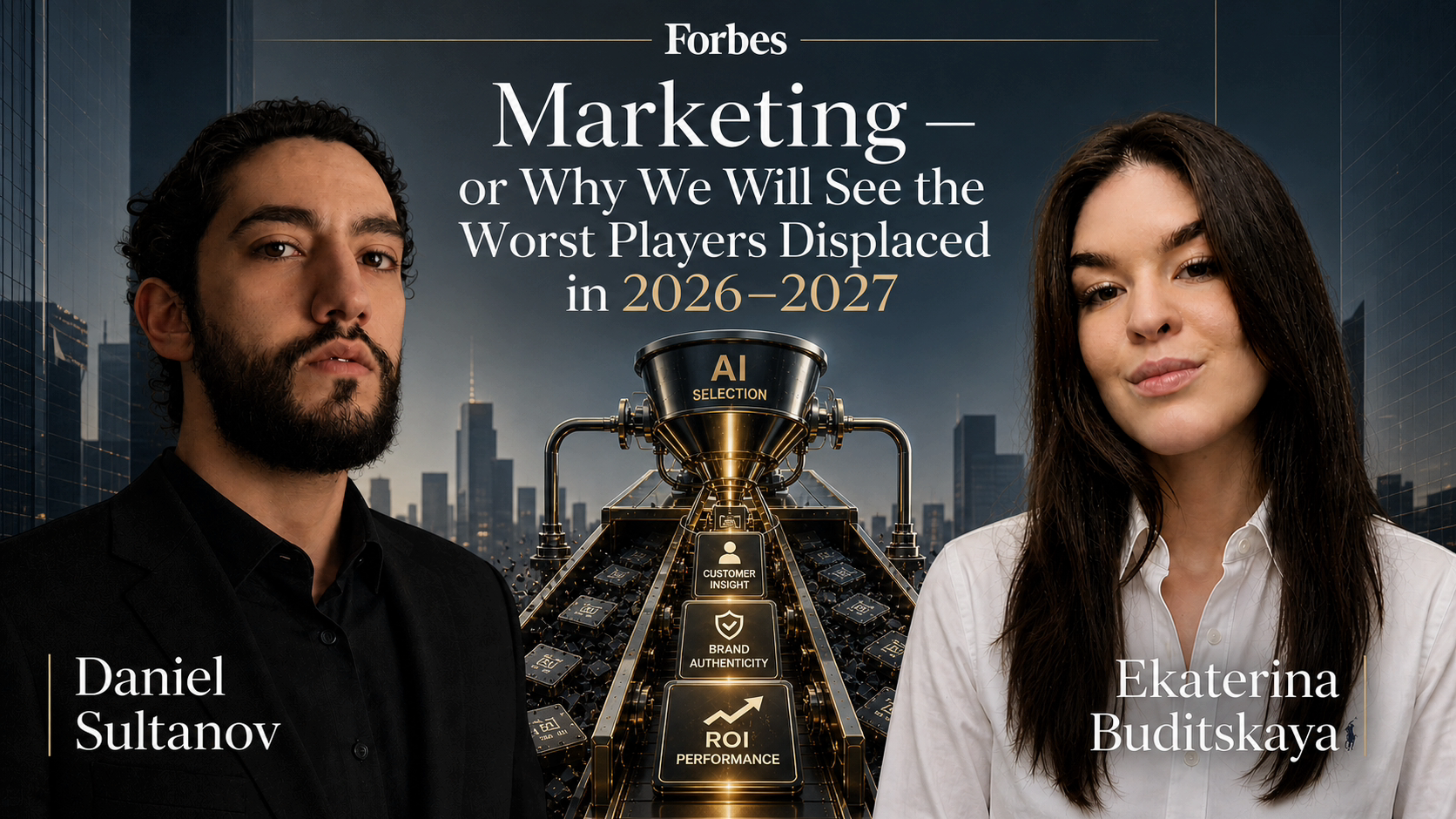
Daniel Sultanov, a serial entrepreneur and founder of a performance marketing agency, specializes in strategic marketing, sales funnel development, product positioning, and growth systems.
Ekaterina Buditskaya is a marketer and project manager with 5 years of experience launching and developing digital, IT, real estate, and automotive projects in international markets. She specializes in strategic marketing, sales funnel building, product positioning, and creating growth systems that turn audience attention into profit.
Together, we’ll explain how marketing operates at the intersection of strategy, creativity, analytics, and business.
The market Is flooded with AI-generated content. Companies are spending more and getting less return on mass advertising. The audience is tired of faceless texts. In such conditions, the winner isn’t the one who generates words faster, but the one who knows how to combine analytics, technology, and human understanding.
Ekaterina:
However, there is another perspective: when used correctly with current trends and relevant topics, bold AI-generated visuals stand out sharply against the sea of generic, monotonous content. But very few manage to break through banner blindness, because simply entering a prompt and churning out videos via a neural network isn’t enough.
The Market In 2026: Overheating and Revaluation
Over the past two years, the content market has experienced what could be called “word inflation.” Generative AI has made text production practically free—and that is precisely the problem. When content ceases to be scarce, it ceases to be valuable.
At the same time, marketing is becoming more expensive and systematic. Companies are shifting from mass advertising to CRM, personalization, and data-driven approaches. Customer experience is becoming more important than reach. Trust is more important than touch frequency. In the new attention economy, depth wins out over volume.
As for the visual and semantic aspects of content, they have also undergone significant changes; creating designs, generating video content, and building entire content machines have become routine for creators. Now anyone can create their own digital avatar, sketch out a website’s UI/UX, or design an IT product interface in just a few hours.
However, because the essence of AI is not to create something new but to piece together a puzzle based on existing data, at some point the market ran into the problem of content “plasticity.”
Daniel:
“When everyone sounds the same, silence becomes a strategy, and the human voice becomes an advantage.”
It is precisely in this context that the profession’s central question arises: if AI can generate content quickly, cheaply, and in any volume, why do we need marketers?
Why the fear arose
The fear of AI in marketing is not unfounded. Over the past few years, neural networks have learned to write press releases, create content plans, generate ad copy, create A/B test versions of headlines, and design visuals. These are all tasks that used to take specialists hours to complete.
The logic seemed Ironclad: if a tool does it faster and cheaper, why pay a human? This argument sounded convincing, and at some point, the era of mass AI-ification of marketing began—until the market started to notice: content created without human involvement performs worse.
Engagement metrics were falling. Conversions weren’t growing. The audience learned to sense the difference between text written in a human voice and text assembled from statistical probabilities. Users began to respond less frequently to digital avatars, which had started replacing real people in content. The fear turned out to be based on a false assumption: that marketing is simply the production of words and images.
What AI Can Do—and What It Can’t
To understand why marketers are indispensable, we must honestly admit that AI does many things better than humans.
What AI Does Well
— Market research and initial data analysis
— Translation, localization, and adaptation of content for different markets
— Automated lead processing and application scoring
— Generation of drafts, variations, and adaptations of content
— Large-scale personalization of messages
— Automation of routine tasks: email campaigns, planning, reporting
— Creating visual content and prototypes — SEO optimization and keyword management
What AI Can’t Do
— Choose a strategy
— Understand what’s important and what isn’t
— Interpret cultural and business context — Make ethical decisions
— Build trust — genuine human trust
— Understand the audience’s unspoken needs
— Create new creative solutions
— Create a unique taste, style, and authorial voice
— Take responsibility for the outcome
AI automates, but it doesn’t strategize. It generates, but it doesn’t understand. It scales, but it doesn’t create meaning. And it is precisely in this gap that the value of a marketer lies.
A New Generation of Marketers
The AI-era marketer is no longer just an executor or a neural network operator. They are an architect of a system where technology serves as a tool, not a replacement for humans. They are a professional capable of creating something new and thinking outside the box, drawing on their own experience. In essence, the modern marketer combines three roles.
Strategist
Understands the market, competitors, growth opportunities, and the audience’s real needs. Determines where to go and why. Formulates the task so that any tool, including AI, works toward a specific business goal. The strategist identifies market and product vulnerabilities that lie beyond the scope of neural network analysis.
Editor
Selects the best of what the system produces. Enhances, reinterprets, and adds the brand’s voice, emotional accuracy, and human intonation. It is the editor who transforms a “standard draft” into content that sticks in the memory. Only they can adjust the visual elements so they catch the eye and evoke the right emotion, as well as ensure there are no inaccuracies that AI often integrates into the content.
Orchestrator
Manages tools, channels, and teams simultaneously. Knows when to turn on automation and when to pause and think. Sees the system as a whole, not just its individual parts. Has a structured path from point A to point B and a memory that isn’t reset with every new session.
“The marketer of the future is like the conductor of an orchestra where AI plays a multitude of instruments. But only a human being is capable of hearing and composing the music.” The key distinction of such a professional is the ability to ask the right questions. Not “how to write the text,” but “why is this text needed” and “what should change in the audience’s mindset after reading it.”
Ekaterina:
Such a specialist is capable not only of bringing a plan to life, but also of creating and generating the key element: the idea. Marketing without an idea is nothing more than technically polished uncertainty. It is the concept that breathes life into any promotional method and product.
An advertising campaign without an idea is just a tool; an advertising campaign with an idea is a living special project that evokes emotion.
Let’s look at an example: there is a TG ads promotion method. And there is the Haval brand, which came up with a brilliant concept—targeting competitors’ channels with specific ad creatives and poking fun at brand names. The campaign went viral, and the brand’s reach skyrocketed.
AI could formulate a promotion strategy and integrate TG ads into it, calculate a media plan, and generate text. But it couldn’t generate the concept itself, as a human did.
Combined content: why the hybrid approach wins
Combined content isn’t just “AI wrote it, a human checked it.” It’s a fundamentally different approach: AI provides structure, speed, and variety, while humans add meaning, emotional accuracy, and trust.
Why does this work better than each option on its own?
Pure AI-generated content is technically accurate but emotionally flat. The audience senses the absence of a human touch, even if they can’t quite explain why. People read this content, but they don’t remember it. They click on it, but they don’t trust it.
Purely human-created content, without technological support, is limited in scale, speed, and personalization. A marketer cannot manually write hundreds of versions of a single message for different audience segments.
A hybrid solution addresses both problems. AI scales what a human has conceived. A human adds meaning to what the AI has generated. Value arises not from the neural network itself, but from a system where technology and humans reinforce each other.
Furthermore, AI is unable to detect visual errors or independently assess the quality of the work produced. It can quickly generate video content, but that content might show a hand with six fingers; the neural network fails to notice details that are obvious to a human. Therefore, the hybrid format helps speed up the workflow and improve the quality of the content produced.
Neuroscience: Why the Brain Notices the Difference
There is a scientific explanation for why combined content works better. It lies in the field of the neurobiology of attention and memory.
The human brain does not memorize information on its own. It remembers what is associated with emotion, personal significance, or novelty. Research in consumer neuroscience shows that advertising stimuli that evoke an emotional response and a sense of reward are retained in memory significantly better than neutral ones.
This means that the “right” content isn’t the kind that simply informs, but the kind that feels alive. The brain recognizes it as meaningful and returns to it again.
AI helps scale the frequency of interactions and the variety of formats, which is crucial for memory formation. But the emotional marker that the brain reads as “this is important” is created by people. That is precisely why the neuro-effect in marketing arises not from the text of a neural network, but from skillfully curated experience: relevance, imagery, emotion, repetition, and vivid tone.
“The brain forgets what is written correctly. It remembers what resonated.” What this means in practice
All of the above has concrete practical implications for those working in marketing today.
If you’re a marketer
Your value doesn’t lie in how quickly you can produce content. It lies in your ability to formulate strategy, interpret data, understand your audience, and bring something to your communications that AI can’t: a human touch, empathy, and meaning. Don’t view AI tools as a threat, but as a lever—they free up time for what truly matters.
AI won’t replace you if you constantly update your knowledge and experience, stay on top of trends, and develop an intuitive feel for the mechanisms that work within your field. only a human can understand the audience’s pain points and provide a witty, intuitive solution to the problem.
If you’re a business
Don’t look for an AI to replace your marketer. Look for a marketer who knows how to work with it. The difference between “using AI” and “knowing how to use AI” is the difference between content that’s created quickly and content that actually works.
Optimize processes, but not the people who are capable of coming up with ideas, creating content, and delivering strong results through a hybrid approach.
If you’re just starting out in the profession
Develop skills that AI cannot replace: strategic thinking, an understanding of audience psychology, storytelling, a keen eye for detail, analytics, and quality control. At the same time, master the tools—not to compete with machines, but to manage them.
Instead of a conclusion
In 2026, marketing faces not the death of the profession, but its evolution. AI will indeed displace those who were only engaged in the mechanical production of content. But it creates new demand for those who can think systematically, understand people, and connect technology with human meaning.
The future of marketing does not lie in AI replacing people. It lies with people who know how to work with AI, understand how their audience thinks, and know that trust cannot be generated—it can only be earned. The future belongs to those who develop their own neural networks, rather than merely inputting prompts into an AI neural network.
“AI is an amplifier. The only question is what exactly it amplifies: weakness or strength.”
Thank you for your attention to our material. We hope the information was useful and helped you see the topic from a new perspective. We would be glad to receive your feedback and continue the conversation.
Daniel Sultanov - Call me in Telegram
Ekaterina Buditskaya - Call me in Telegram


