AI Did Not Start With ChatGPT. It Started With a Question About the Human Mind
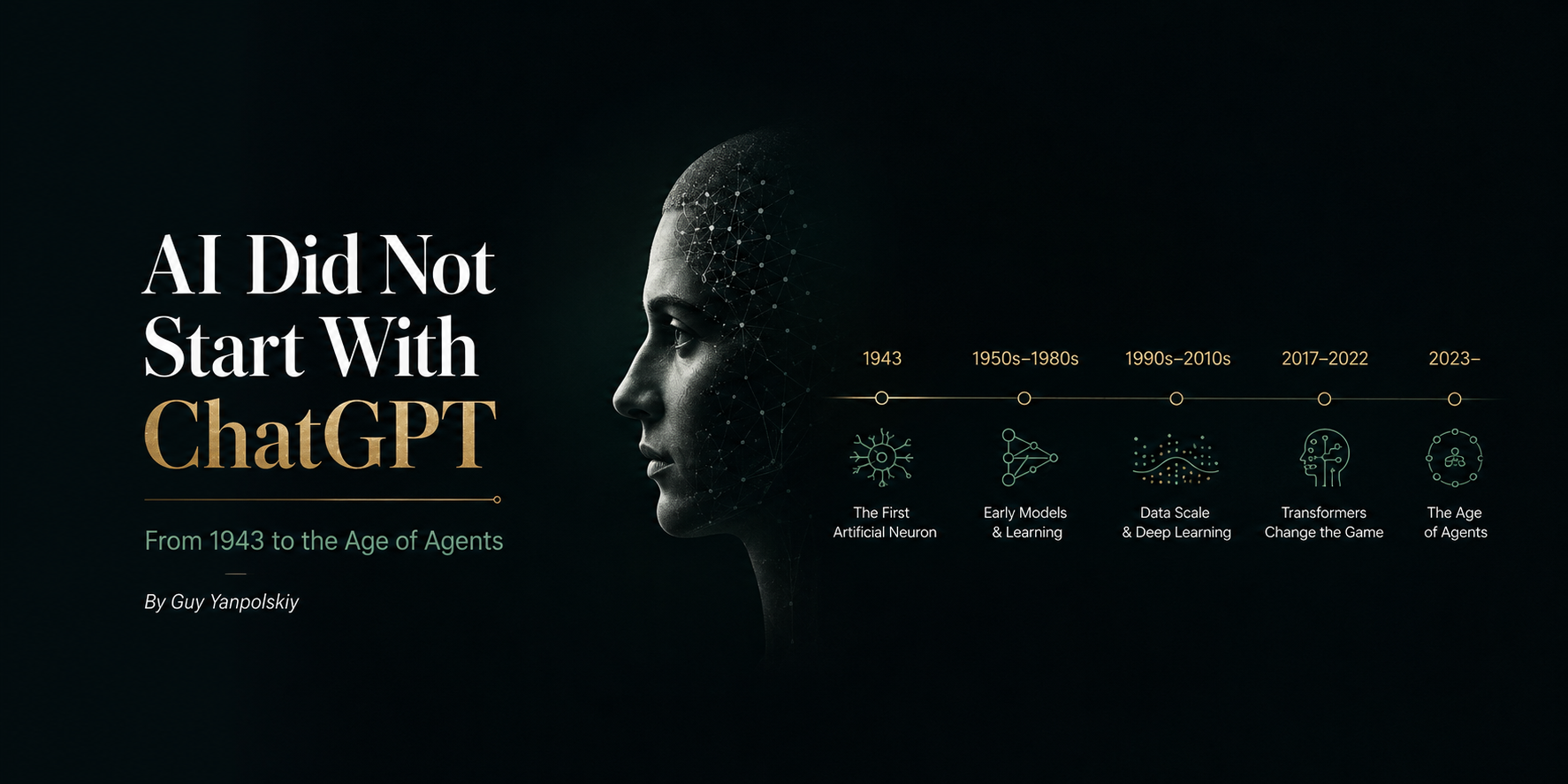
When most people think about artificial intelligence, they think about ChatGPT, image generators, AI agents, and the current wave of tools changing business, media, education, and search.
But artificial intelligence did not begin in 2022.
ChatGPT made AI visible to the world.
It did not create the field.
The real story of AI started almost eighty years earlier — not with a chatbot, but with a much deeper question:
Can human thinking be described, modeled, and eventually reproduced by a machine?
That question has shaped one of the most important technological journeys in modern history.
And today, as AI becomes part of every business, every search engine, every brand reputation system, and every decision-making process, understanding this history is no longer just academic.
It is strategic.
Because the companies that understand where AI came from will be better prepared for where it is going.
The First Artificial Neuron
In 1943, Warren McCulloch and Walter Pitts proposed a mathematical model of a neuron.
The idea was simple, but powerful: a neuron receives inputs, processes signals, and produces an output. If the signal reaches a certain threshold, the neuron activates.
Today, this may sound basic. But at the time, it was revolutionary.
For the first time, the brain was not only a biological mystery. It could also be seen as an information-processing system.
This was the beginning of the neural network idea — the foundation that would later lead to deep learning, large language models, and modern generative AI.
The important lesson is this: AI began not as a product, but as a model of intelligence.
1956: The Birth of Artificial Intelligence as a Field
In 1956, a group of researchers gathered at Dartmouth College for what is now considered the founding moment of artificial intelligence as a discipline.
John McCarthy, Marvin Minsky, Claude Shannon, and Nathaniel Rochester proposed a research project around “artificial intelligence.”
Their belief was ambitious: if human intelligence could be precisely described, then machines could be built to simulate it.
This was the first great promise of AI.
But it was also the first great overestimation.
The early pioneers believed that major progress could happen quickly. In reality, it would take decades of theory, failures, funding cuts, computing breakthroughs, and data infrastructure before AI could become what we see today.
This pattern has repeated throughout AI history:
First comes excitement.
Then unrealistic expectations.
Then disappointment.
Then quiet progress.
Then a breakthrough.
AI has never moved in a straight line.
It has moved in waves.
The Perceptron: The First Machine That Learned
In 1958, Frank Rosenblatt introduced the perceptron — one of the earliest systems that could learn from examples.
This was a major conceptual shift.
Traditional software followed instructions written by humans.
The perceptron showed that a machine could adjust itself based on data.
That idea is still at the center of modern AI.
Data enters the system.
The model makes a prediction.
The system measures the error.
The model adjusts.
The cycle repeats.
This is the basic logic behind machine learning.
The difference today is scale.
Instead of small experimental systems, we now have models trained on massive datasets, running on advanced chips, inside global cloud infrastructure.
But the principle remains the same: learning from data.
Symbolic AI: When Machines Followed Rules
While neural networks tried to learn from data, another branch of AI took a different path: symbolic AI.
Symbolic AI was based on rules, logic, and structured knowledge.
For example:
If a patient has symptom A,
and test result B,
then diagnosis C may be likely.
This approach powered early expert systems in medicine, chemistry, engineering, and corporate decision-making.
Systems like ELIZA, DENDRAL, and MYCIN showed that computers could imitate conversation, assist with scientific analysis, and support expert reasoning.
This matters because the first real business use cases of AI did not look like ChatGPT.
They looked like decision systems.
AI was not always a creative assistant.
It was first a logic engine.
The First AI Winter
By the late 1960s and early 1970s, the early enthusiasm around AI began to weaken.
Researchers discovered that many systems were far more limited than expected. The perceptron, for example, could not solve certain simple problems in its original form.
The issue was not that AI was impossible.
The issue was that the technology around AI was not ready.
There was not enough computing power.
There was not enough data.
There were not enough practical training methods.
There was too much hype.
Funding decreased. Expectations collapsed. The first “AI winter” began.
This is one of the most important lessons in the history of technology:
A good idea can still fail temporarily if the infrastructure around it is not ready.
AI did not die.
It waited.
The Return: Expert Systems and Backpropagation
In the 1980s, AI returned through expert systems.
Corporations used AI-like systems to capture expert knowledge and automate decisions. These systems created real business value, especially in technical and industrial environments.
At the same time, neural networks received a major boost through the popularization of backpropagation — a method that allowed multilayer neural networks to learn more effectively.
Backpropagation made it possible for networks to adjust internal weights across multiple layers. This was a key step toward modern deep learning.
But once again, the world was not fully ready.
Computers were still limited.
Data was still limited.
Systems were expensive to maintain.
By the late 1980s and early 1990s, another AI winter arrived.
The market had expected too much, too fast.
Again, AI did not disappear.
It moved underground into statistics, search, speech recognition, fraud detection, recommendation systems, and early machine learning.
AI Became Invisible Infrastructure
In the 2000s, AI quietly entered everyday life.
Most people did not call it AI.
But it was already there.
Search engines used machine learning.
Email platforms used spam detection.
Banks used fraud models.
E-commerce platforms used recommendations.
Advertising systems used prediction engines.
Translation tools improved.
Voice recognition became more practical.
AI became part of the infrastructure of the internet.
It was not a robot.
It was not a talking machine.
It was a hidden layer inside digital systems.
This is an important point for business leaders:
AI becomes truly powerful when it stops looking like a separate technology and becomes part of the operating system.
That is exactly what is happening again today.
2012: The Deep Learning Breakthrough
In 2012, deep learning had its major modern breakthrough when AlexNet achieved a dramatic result in image recognition.
This moment changed the perception of neural networks.
For decades, neural networks had been interesting but limited. Suddenly, they were outperforming traditional methods in computer vision.
Why did it work now?
Because three forces finally came together:
More data.
Better algorithms.
More powerful GPUs.
This is the real formula behind modern AI.
Not just intelligence.
Infrastructure.
AI does not scale because of magic.
It scales because of chips, data, cloud computing, software frameworks, and capital.
The 2012 breakthrough opened the door to modern computer vision, speech recognition, recommendation systems, medical imaging, autonomous systems, and more.
2017: The Transformer Changed Everything
In 2017, researchers introduced the Transformer architecture in the paper “Attention Is All You Need.”
This was one of the most important moments in the history of AI.
The Transformer made it possible to process language more efficiently and at much greater scale. It became the foundation for modern large language models.
GPT, BERT, Claude, Gemini, and many other systems belong to the Transformer era.
The key idea was attention: the model could learn which parts of the input mattered most in relation to other parts.
This was not just a technical improvement. It changed the direction of the entire field.
AI moved from narrow task systems toward large, flexible models that could work across many types of language tasks.
Eventually, this led to the rise of generative AI.
ChatGPT Made AI Mass Market
When ChatGPT was released in 2022, it did not invent artificial intelligence.
But it changed the relationship between humans and AI.
For the first time, millions of people interacted with AI through natural conversation.
No code.
No complex interface.
No technical training.
Just a chat box.
That simplicity changed everything.
AI became understandable.
AI became usable.
AI became emotional.
AI became part of daily work.
For businesses, this was the real turning point.
Before ChatGPT, AI was often seen as something for engineers, data scientists, or large technology companies.
After ChatGPT, every founder, marketer, lawyer, consultant, student, journalist, and executive could immediately understand the value.
The interface made the revolution visible.
From Generative AI to AI Agents
The next phase is already here.
AI is moving from answering questions to taking actions.
This is the rise of AI agents.
An AI agent can read a task, break it into steps, use tools, search information, write code, analyze files, update systems, and execute workflows.
This changes the role of AI from assistant to operator.
The first wave of generative AI was about content.
The second wave is about productivity.
The third wave will be about autonomous execution.
That has massive consequences for every industry.
Marketing teams will use agents for research, content, distribution, and reporting.
Sales teams will use agents for lead qualification and outreach.
Legal teams will use agents for document review.
Finance teams will use agents for analysis and compliance.
Media teams will use agents for monitoring and reputation.
Founders will use agents as operational leverage.
The question is no longer: “Can AI write text?”
The real question is: “What parts of the business can AI operate?”
AI Is Changing Search and Reputation
One of the biggest changes is happening in search.
For the last twenty years, companies competed for visibility in Google.
They optimized pages.
They bought ads.
They built backlinks.
They created SEO strategies.
But now users are increasingly asking AI systems for answers.
They ask ChatGPT.
They ask Gemini.
They ask Perplexity.
They ask AI assistants inside browsers, phones, and productivity tools.
This creates a new reality:
Your brand is no longer only being ranked.
It is being interpreted.
AI systems do not simply show ten links.
They summarize.
They compare.
They decide what matters.
They cite some sources and ignore others.
This is where GEO — Generative Engine Optimization — becomes critical.
GEO is not just the next version of SEO.
It is a new discipline focused on how brands, people, companies, and ideas are understood by AI systems.
In the AI era, reputation is not only what people say about you.
It is what machines can verify, connect, and explain about you.
This is why authority signals matter more than ever:
credible media,
consistent messaging,
clear entity data,
expert positioning,
structured knowledge,
trusted citations,
real-world proof.
If AI cannot understand who you are, what you do, and why you matter, you may become invisible in the next layer of search.
The Future Belongs to Interpretable Brands
The next competitive advantage will not belong only to companies that use AI tools.
It will belong to companies that AI systems can correctly understand.
That means brands must become more structured, more consistent, and more credible.
A company cannot say five different things about itself across ten platforms and expect AI to understand it clearly.
The AI layer rewards clarity.
It rewards authority.
It rewards consistency.
It rewards evidence.
It rewards reputation.
This is a major shift.
In the old internet, visibility was about traffic.
In the AI internet, visibility is about trust.
The question is no longer only:
“How do we get users to our website?”
The new question is:
“How do we make sure AI systems describe us correctly when users ask about our market?”
That is a completely different game.
The Real Lesson of AI History
The history of AI teaches us one thing clearly:
AI is not a sudden event.
It is a long accumulation.
The artificial neuron in 1943.
The Dartmouth conference in 1956.
The perceptron in 1958.
Expert systems in the 1980s.
Machine learning in the 1990s and 2000s.
Deep learning in 2012.
Transformers in 2017.
ChatGPT in 2022.
Agents in the mid-2020s.
Each phase looked separate at the time.
But together, they form one story: the gradual construction of a new intelligence infrastructure.
And now this infrastructure is entering every part of society.
Business.
Education.
Media.
Law.
Healthcare.
Finance.
Government.
Reputation.
Search.
Human creativity.
The companies that treat AI as a trend will use it for small productivity gains.
The companies that treat AI as infrastructure will redesign how they operate.
Final Thought
AI did not begin with ChatGPT.
ChatGPT was the moment the world finally saw what had been developing for decades.
Now we are entering a new phase — one where AI is not only a tool, but a layer between people and information.
That means every company, every founder, every public figure, and every institution must ask a new strategic question:
Are we understandable to artificial intelligence?
Because in the next era, it will not be enough to be online.
It will not be enough to publish content.
It will not be enough to have a website.
It will not even be enough to be known by people.
You will need to be legible to machines.
The future of visibility is not only search ranking.
It is interpretation.
And the brands that AI can interpret correctly will have a major advantage over those it cannot see clearly.


