2026: The Year AI Left the Screen and Entered the Physical World
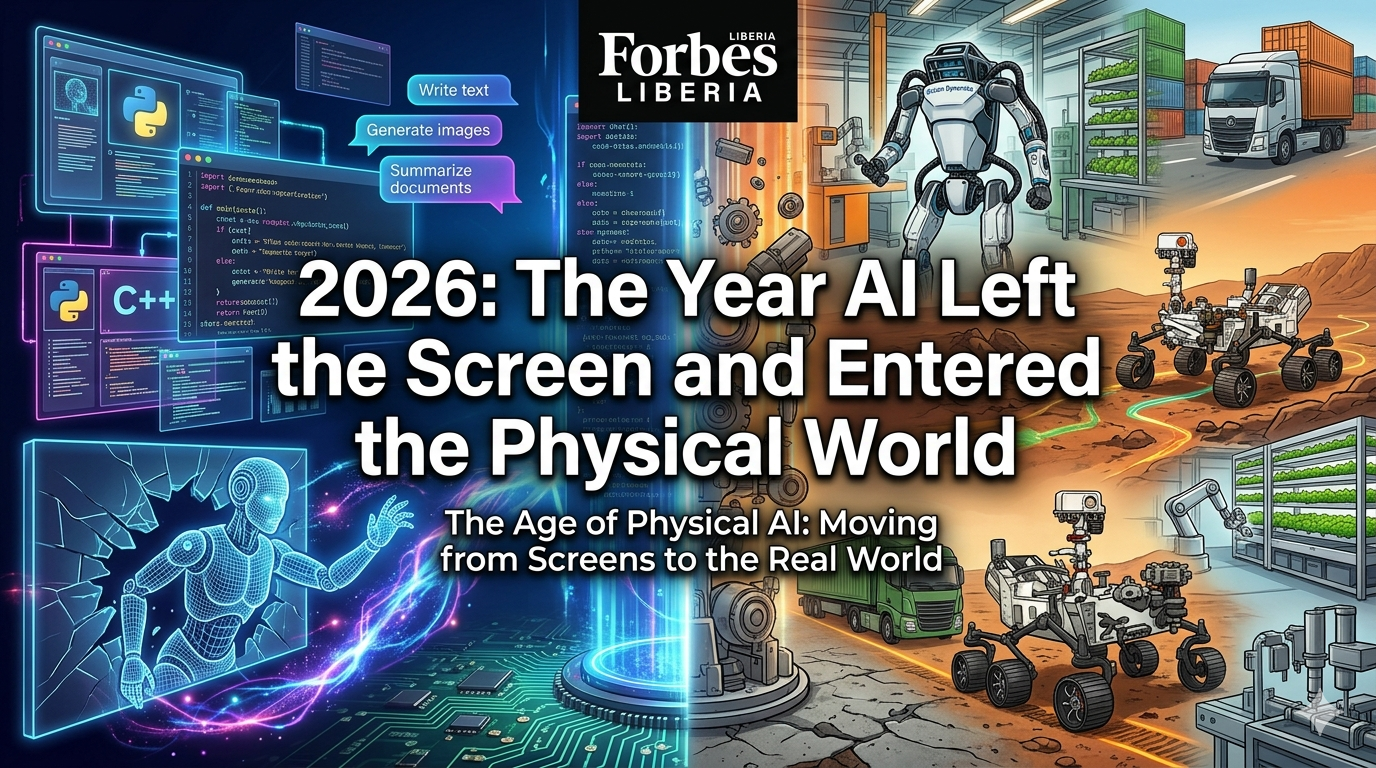
For years, artificial intelligence was something we experienced through screens.
It wrote text.
It generated images.
It helped with code.
It summarized documents.
It answered questions.
But 2026 is showing us something much bigger: AI is no longer staying inside the interface.
It is beginning to move through the physical world.
It is entering factories, robots, vehicles, laboratories, space missions and industrial systems. We are moving into the age of Physical AI — artificial intelligence that does not only think, analyze or respond, but also plans, moves and acts in real environments.
Several recent developments make this shift impossible to ignore.
In January 2026, Boston Dynamics introduced the product version of its new all-electric Atlas humanoid robot. This was not just another viral demo or research prototype. Boston Dynamics presented Atlas as a production-focused platform, with initial deployments planned with Hyundai and Google DeepMind.
That matters.
For years, humanoid robots were treated as symbols of the future — impressive, fascinating, but still far from everyday commercial use. Atlas now represents a different stage: the transition from robotics as spectacle to robotics as infrastructure.
Hyundai, which owns Boston Dynamics, is building a broader strategy around AI robotics and human-robot collaboration. The goal is not simply to create a robot that looks human. The goal is to create machines that can operate in real industrial environments, take on repetitive or physically demanding tasks, and eventually become part of the modern manufacturing stack.
According to Reuters, Hyundai plans to begin deploying Atlas at its Georgia facility from 2028, with a longer-term ambition to produce up to 30,000 robots per year.
This means the question is no longer: “When will robots arrive?”
They have arrived.
The real question now is: who will learn to integrate them into production, logistics, operations and management faster than everyone else?
At the same time, AI is also beginning to influence autonomous decision-making far beyond Earth.
NASA and Anthropic recently shared that Claude helped engineers at NASA’s Jet Propulsion Laboratory plan a route for the Perseverance rover on Mars. In December 2025, Perseverance drove roughly 400 meters across the Martian surface following a route planned with the assistance of AI.
At first, 400 meters may not sound like much. But the distance is not the point.
The point is that an AI system became part of a real decision-making process in one of the most complex operating environments imaginable. On Mars, humans cannot control a rover in real time. The signal delay between Earth and Mars means every movement must be planned carefully in advance. Engineers have to evaluate terrain, rocks, slopes, hazards and operational constraints before the rover moves.
In that context, AI becomes more than a productivity tool.
It becomes a planning layer for autonomous action in a difficult physical environment.
A third signal comes from China’s Unitree.
Unitree’s G1 humanoid robot has become one of the clearest examples of how quickly the economics of robotics are changing. The G1 was introduced with a starting price of around $16,000. For the average consumer, that is still expensive. But for universities, laboratories, startups, R&D teams and educational institutions, it represents a very different level of accessibility.
Until recently, humanoid robots were associated with research budgets, large corporations or prices well above $100,000. Unitree’s G1 suggests that the cost curve is starting to move in the same direction we already saw with AI software: from elite labs to wider adoption.
This is important because technology does not become truly transformative only when it is invented. It becomes transformative when it becomes accessible.
First, large language models became available to millions of people through simple chat interfaces. Then image and video generation became available through consumer tools. Now a similar process is beginning in robotics.
Physical AI is slowly moving out of the laboratory and into the market.
Boston Dynamics, NASA, Anthropic, Hyundai, Google DeepMind and Unitree may look like separate stories. But they are all pointing to the same deeper shift.
AI is moving through three major stages.
The first stage was informational AI.
This is the AI most people know today. It writes, searches, summarizes, translates, analyzes and generates ideas. It transforms knowledge work, media, marketing, software development, education and customer support.
The second stage is agentic AI.
Here, AI does not simply answer. It performs tasks. It plans, compares, books, executes workflows, uses tools and makes intermediate decisions. This is where AI becomes less like a search box and more like an operational assistant.
The third stage is physical AI.
This is when AI gains a body. That body may be a humanoid robot, a rover, a vehicle, a drone, a warehouse machine, an industrial arm or an autonomous system inside a factory.
This third stage may be the most economically important.
As long as AI remained inside screens, it mainly affected knowledge work. But once AI enters physical systems, it begins to transform manufacturing, logistics, construction, agriculture, healthcare, space exploration, transportation and urban infrastructure.
That is not just office automation.
That is a new architecture of labor.
Of course, this does not mean robots will replace humans overnight. The first wave of physical AI will likely focus on jobs that are repetitive, dangerous, physically demanding or difficult to staff. In factories, robots can support tasks involving heavy movement, repeated handling, inspection or sequencing of parts. In space, AI can help plan routes where human control is delayed. In research and education, lower-cost humanoids can help accelerate experimentation.
But over time, the deeper question becomes unavoidable:
What happens to the role of the human when machines can not only think, but also act?
The human role does not disappear. It changes.
Humans become process architects, system supervisors, robot trainers, scenario designers, quality controllers and ethical decision-makers. Where machines take over movement, humans must take greater responsibility for context, purpose, judgment and trust.
This may be the most important shift of 2026.
AI is no longer just helping people work faster. It is becoming a new layer between human intention and action in the physical world.
In the old model, a person gave a command and a machine executed it.
In the new model, a person defines a goal, and an AI-enabled system plans, adapts, chooses a path and acts through a physical body.
A rover moves across Mars.
A humanoid robot prepares for factory work.
A Chinese company lowers the entry cost of humanoid robotics.
Foundation models begin connecting with machines that move in the real world.
This is not a collection of isolated announcements.
It is the outline of a new era.
In this era, the main competitive advantage will not belong only to companies with the best AI model. It will belong to those who can connect four layers:
intelligence, body, data and trust.
Intelligence allows the system to understand the task.
The body allows it to act in the physical world.
Data allows it to learn from reality.
Trust allows humans to accept these systems inside factories, cities, transport, homes and critical infrastructure.
Trust may become the most important layer of all.
Not hardware.
Not algorithms.
Not impressive conference demos.
Trust.
Because an error from a chatbot is a bad answer.
An error from physical AI is an event in the real world.
That is why the next major industry will not simply be “robots.” It will be trusted physical AI — systems that are verifiable, controllable, safe, explainable and capable of operating near humans.
The future did not arrive as one giant science-fiction robot.
It arrived through a factory platform, a Mars rover, a more affordable Chinese humanoid and AI models beginning to participate in real-world decision-making.
AI is no longer only speaking.
It has started to move.


